Sensing on the signals your network already sends. An open-source 5G NR testbed that turns a mobile network into a sensor, with no radar hardware and no extra spectrum.
Integrated Sensing and Communication, on standard 5G
Integrated Sensing and Communication turns a mobile network into a sensor. The same base station that carries traffic also detects what moves around it, with no radar hardware and no extra spectrum.
ISAC node nrUE is an open-source testbed for exactly that. An OCUDU RAN transmits ordinary 5G downlink reference signals; a second antenna on the same mast listens for the reflections and turns them into a live range-Doppler map. The sensing rides on CSI-RS, the reference signals every 5G cell already transmits, so the waveform stays fully standards-compliant and any deployed cell becomes a potential sensor. The cost is one extra receive antenna, not a redesign.
Sensing is parasitic on CSI-RS the cell already sends.
Nothing added to the air interface; fully 3GPP-compliant.
One extra receive antenna, off-the-shelf SDR, no redesign.
UE tap, wire format and receiver published; reproducible.
Pseudo-monostatic ISAC on 5G NR CSI-RS, sensing parasitic on the downlink
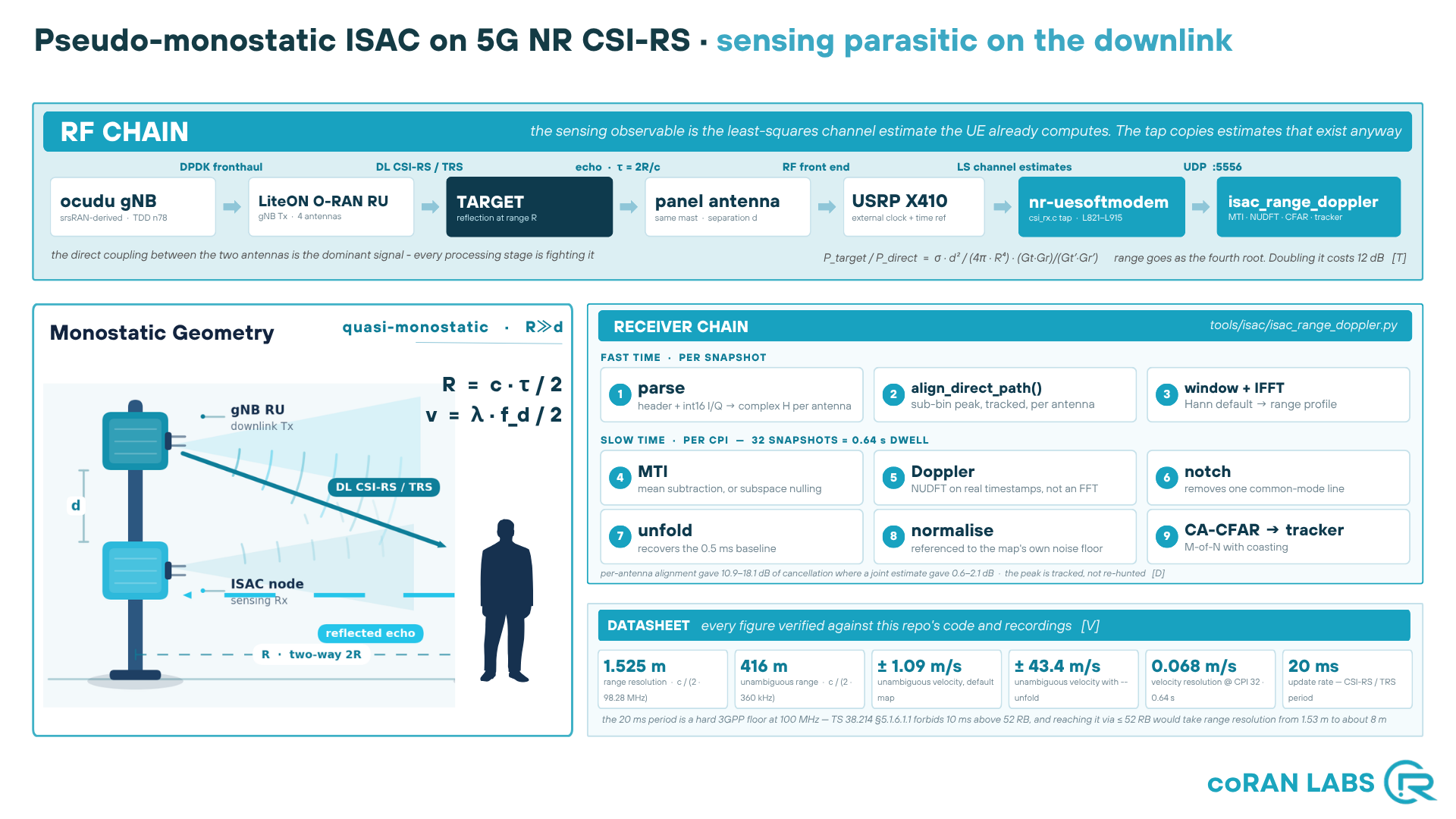
The RF chain runs OCUDU gNB → LiteON O-RAN RU → target → panel antenna → USRP X410 → nr-uesoftmodem → the range-Doppler receiver. The dominant signal is the direct coupling between the two co-located antennas, and every processing stage is built to fight it.
Delay gives distance. Frequency shift gives speed. Both come from signals the network already sends.
The sensing observable is the least-squares channel estimate the UE already computes. The tap copies estimates that exist anyway. It adds no PHY processing.
Off-the-shelf hardware throughout. Every part is commercially available or open source.
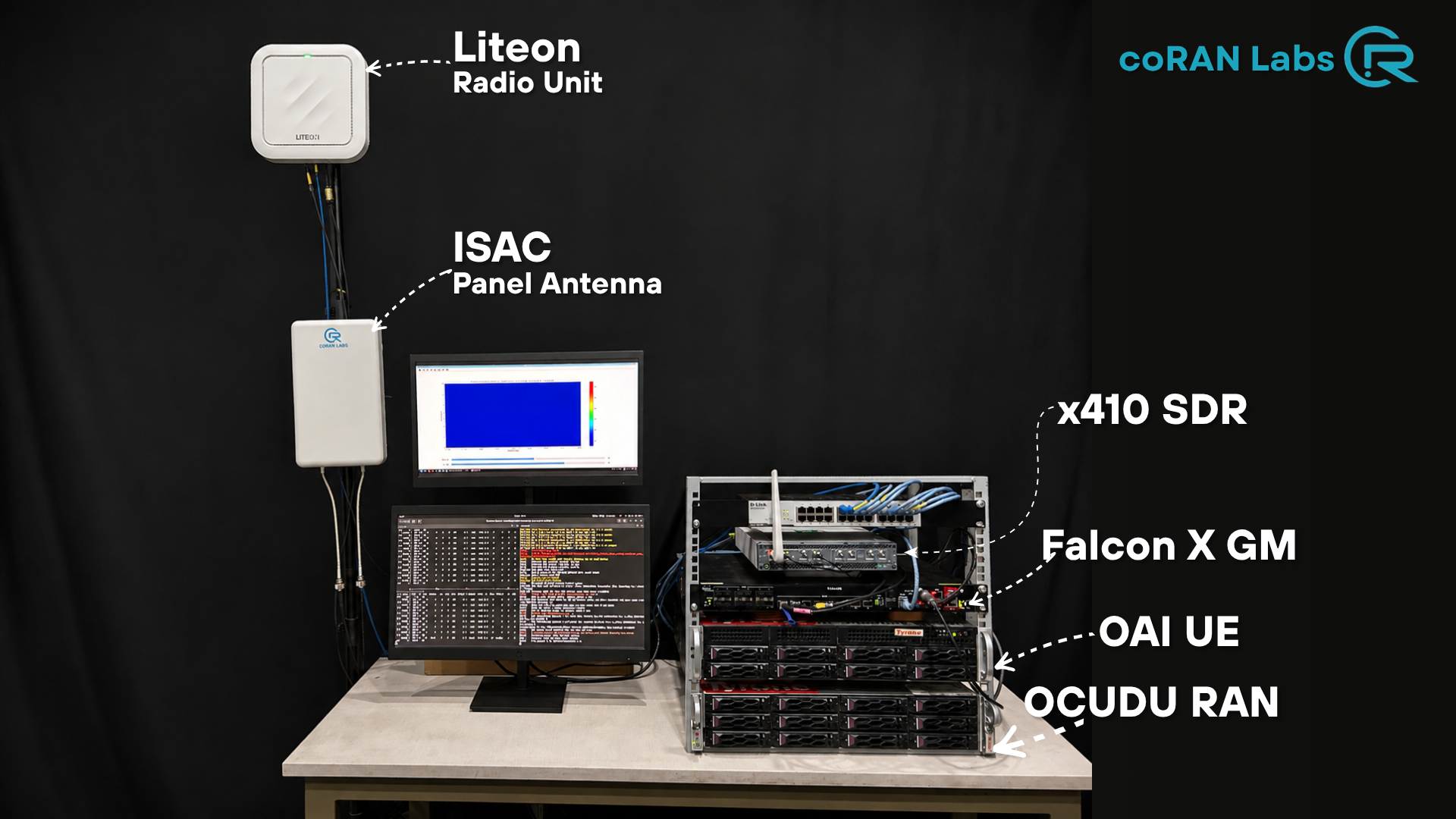
An OCUDU RAN drives a LiteON O-RAN radio unit over DPDK fronthaul, on band n78 at 100 MHz. The transmit side is a standard 5G cell.
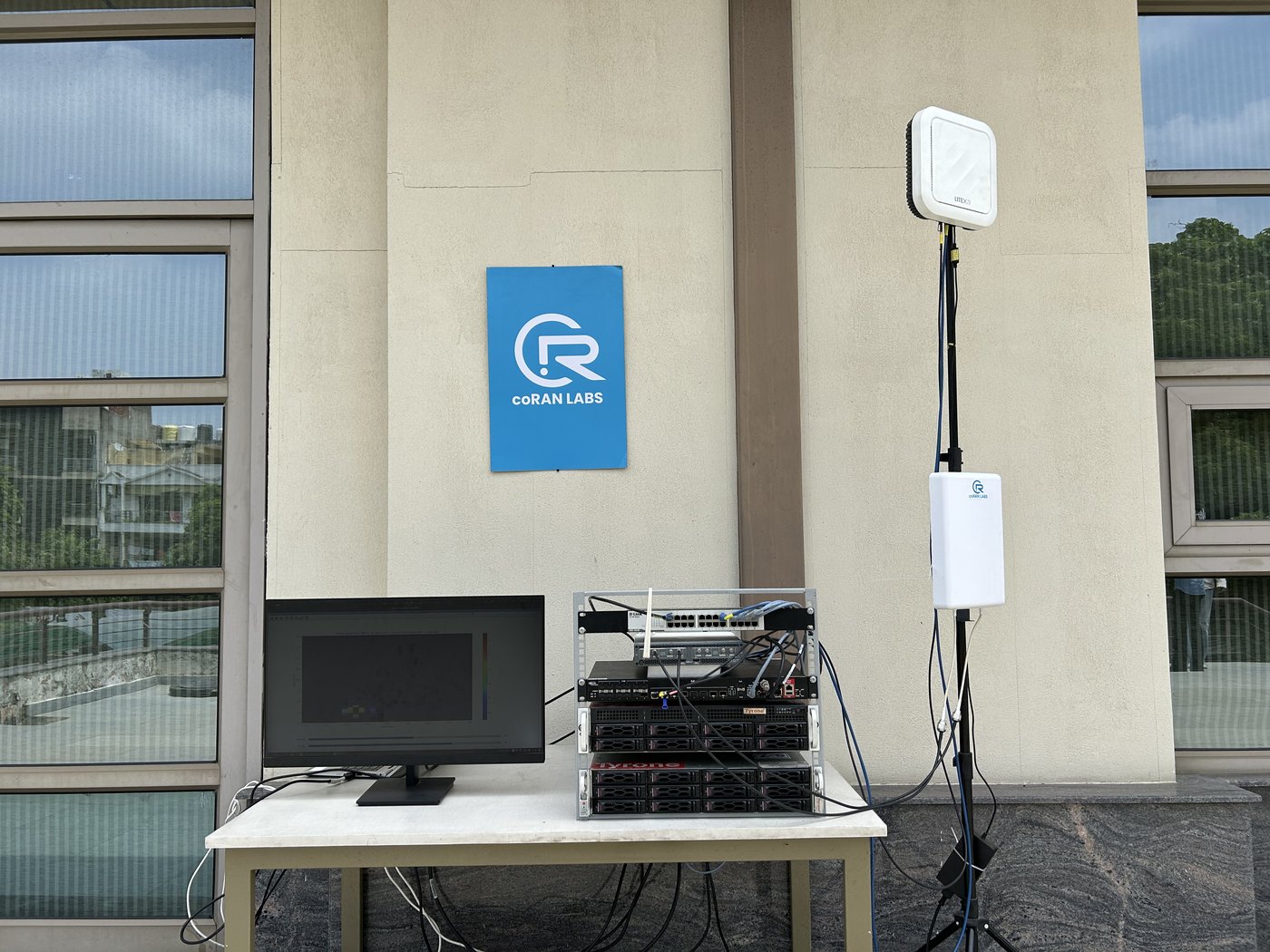
The ISAC panel antenna and the RU share one mast. A USRP X410 SDR feeds the UE as the sensing receiver.
A Falcon X GM supplies a common clock and time reference so transmitter and receiver stay coherent. The receiver is an OpenAirInterface UE with the sensing tap.
A walkthrough of the ISAC testbed sensing live on 5G NR reference signals.
A motion and Doppler sensor. 100 MHz carrier in band n78, measured against the repo's own code and recordings.
The UE tap, the streaming format and the full receiver are published under the same licence as OpenAirInterface, along with the tooling used to verify them. It is a fork of Duranta OpenAirInterface that adds two new source files and 17 lines of integration. Everything else is stock upstream.
Explore the open-source ISAC testbed, or talk to us about integrated sensing on your 5G deployment.